
The Claude Ban Is Bigger Than AI: It’s About Who Controls Imagination

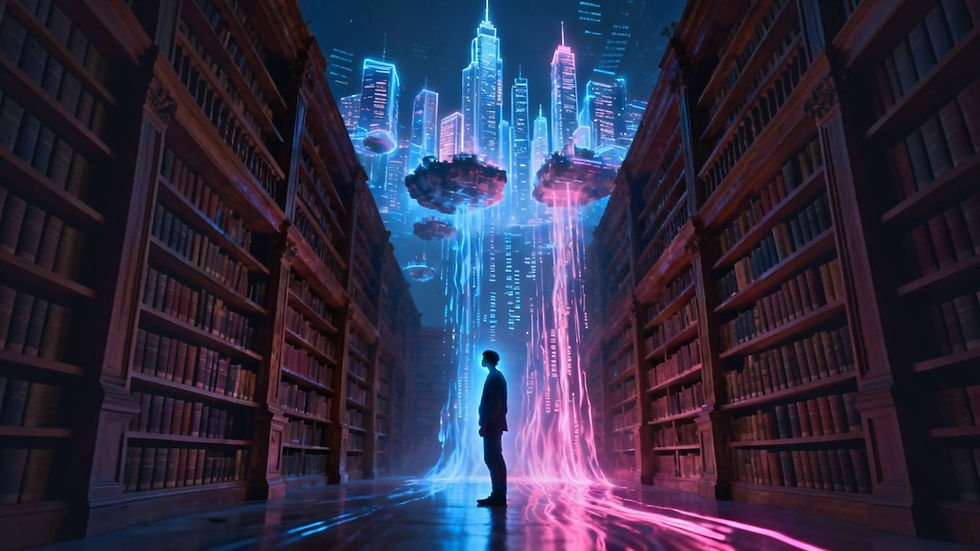
In 1954, governments worried about television. In the 1990s, they worried about the internet. By the 2010s, social media had become the dominant concern, with lawmakers, regulators, and citizens debating its influence on politics, culture, and society. Today, a new technology has entered that lineage of disruption. This time, however, the debate is not simply about communication. It is about imagination itself.
The controversy surrounding AI storytelling tools such as Claude's Fable capabilities is often presented as a discussion about copyright, safety, misinformation, or intellectual property. Those concerns are real and deserve serious attention. Yet they only explain part of the reaction. Beneath the surface lies a much larger question—one that has appeared repeatedly throughout history whenever a new medium has emerged. Who gets to decide which stories are told, how they are distributed, and who has the power to create them?
For centuries, the ability to shape public imagination was concentrated in the hands of a relatively small number of institutions. Publishers determined which books reached readers. Film studios decided which scripts became movies. Television networks controlled what audiences watched each evening. Even in the supposedly democratic era of social media, algorithms and platforms quietly became the new gatekeepers of attention. While creativity itself was widespread, access to audiences remained limited. The result was a system where a handful of organizations held enormous influence over culture.
Generative AI threatens to disrupt that arrangement in a way few technologies have before. For the first time, the tools required to create stories, fictional worlds, characters, dialogue, and even entire universes are becoming available to anyone with an internet connection. A process that once required teams of writers, artists, editors, producers, and distributors can increasingly be initiated with a prompt. The barriers that protected traditional creative industries are beginning to weaken, and with them, the institutions that have long controlled the flow of imagination.
Why Storytelling AI Feels Different From Coding AI
This is why the debate around AI storytelling feels fundamentally different from the debate around AI coding or productivity software. When artificial intelligence learned to write code, the conversation focused largely on efficiency. Businesses wondered how much faster software could be built. Workers questioned how their jobs might evolve. Investors discussed productivity gains and economic impact. Storytelling, however, occupies a different place in society. Code builds products and stories build cultures.
Every civilization is ultimately shaped by narratives. Nations are built around shared stories of identity and purpose. Religions rely on stories to transmit values across generations. Brands spend billions creating narratives that influence consumer behavior. Even financial systems depend on collective belief in stories about value, trust, and future outcomes.
The ability to generate stories at scale is therefore not merely a creative capability. It is a form of influence. Throughout history, those who controlled narratives often exercised influence far beyond their size. This is precisely why AI storytelling generates stronger emotional reactions than many other forms of artificial intelligence. People instinctively understand that stories shape how societies think, behave, and evolve.
The Disney Problem Nobody Is Talking About
The implications become even more significant when viewed through the lens of modern entertainment. For decades, the world's most successful media companies have built their fortunes around ownership of fictional universes. Marvel, Star Wars, Harry Potter, and Pokémon are not merely intellectual properties. They are cultural ecosystems that generate revenue through books, films, merchandise, games, and experiences. Their value comes from scarcity. These worlds are unique, recognizable, and difficult to replicate.
AI introduces a radically different possibility. Imagine a future where every individual can generate a personalized universe tailored specifically to their preferences. Characters evolve based on their interests. Stories adapt to their emotions. Entire worlds expand infinitely, unconstrained by production budgets or release schedules.
In such a future, the competition facing entertainment companies is no longer another studio. It is unlimited imagination. That prospect represents a challenge far greater than piracy ever posed. Piracy copied existing content. AI creates entirely new content. One threatens revenue streams. The other threatens the economics of scarcity upon which much of the entertainment industry has been built.
For entertainment giants, the greatest competitor of the future may not be another company. It may be an AI-powered audience that can create exactly what it wants.
Every Communication Revolution Creates New Gatekeepers
History suggests that moments like this rarely unfold without resistance. Every major communication revolution has triggered fears about who gains power and who loses it. The printing press weakened religious authorities while empowering publishers. Radio shifted influence away from newspapers and toward broadcasters. The internet disrupted broadcasters and elevated digital platforms. Social media empowered creators while simultaneously concentrating influence within a handful of technology companies.
Artificial intelligence may follow a similar pattern. While many people imagine AI as a force that democratizes creativity, it may also create new concentrations of power. The companies developing advanced models, the organizations controlling computing infrastructure, and the governments establishing regulatory frameworks could become the next generation of cultural gatekeepers.
This is where the debate becomes more complicated. Concerns about copyright and safety are legitimate. Yet history also teaches us that societies often frame disruptive communication technologies as dangerous when they begin redistributing influence away from established institutions. The challenge is determining where legitimate regulation ends and narrative control begins.
When Imagination Becomes Infrastructure
What makes the Claude controversy particularly fascinating is that it serves as a preview of a much larger struggle. Whether one company restricts storytelling features is ultimately less important than the broader trajectory of the technology itself.
AI systems are becoming increasingly capable of generating narratives, building characters, creating visual content, and adapting stories in real time. These capabilities are improving across the industry, not within a single platform. The question is no longer whether AI-generated storytelling will exist. It already does. The real question is who will control it.
Governments will argue for oversight. Technology companies will argue for responsible deployment. Entertainment companies will argue for stronger protections of intellectual property. Open-source communities will argue for creative freedom. Each perspective contains valid concerns, yet all are competing for influence over the same thing: the future architecture of imagination.
Throughout history, societies have invested heavily in physical infrastructure because infrastructure shapes what becomes possible. Railroads transformed commerce, electricity transformed industry, telecommunications transformed information and the internet transformed connectivity. The AI era may introduce a new category altogether: imagination infrastructure.
Systems capable of generating stories, identities, experiences, and cultural narratives at unprecedented scale may become as strategically important as communication networks or cloud computing platforms. The organizations that control these systems may wield influence comparable to the largest media companies, technology platforms, and perhaps even governments themselves.
That is why debates surrounding AI storytelling provoke such strong reactions. The controversy is not merely about whether a machine can write fiction. It is about who will own, regulate, and distribute one of humanity's most powerful resources: the ability to shape how people imagine the world and throughout history, few forms of power have proven more valuable—or more fiercely contested—than that.




Comments