
The New Industrial Giants: Why MANGOS Companies Matter More Than Governments Think

For much of modern history, economic power was easy to identify. It was measured in oil fields, factories, railroads, shipping routes, and industrial output. Nations became powerful because they controlled physical infrastructure. Companies became influential because they produced the materials, machinery, and energy that powered economies.
Today, a different kind of industrial power is emerging. The world's most influential companies are no longer defined by what they manufacture. They are defined by what they control—information, attention, compute, intelligence and connectivity.
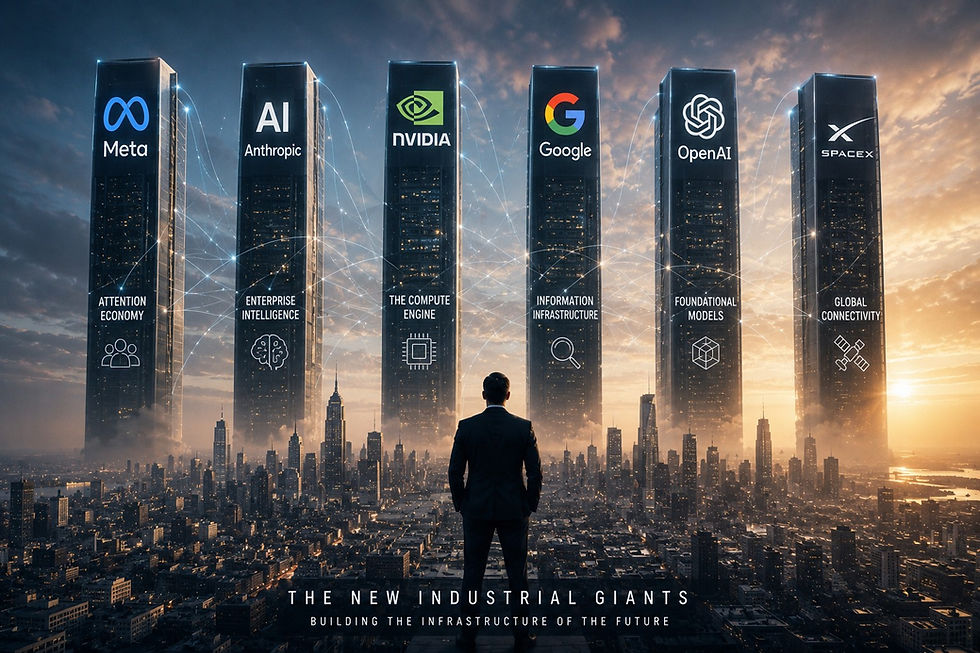
This is where a new group of companies enters the picture. Often referred to as MANGOS—Meta, Anthropic, NVIDIA, Google, OpenAI, and SpaceX—they represent something larger than the latest generation of technology firms. They are becoming infrastructure providers for the modern economy and in some areas, their influence may be growing faster than the ability of governments to regulate or even fully understand it.
Industrial Power Has Moved From Physical Assets to Digital Infrastructure
The most valuable companies of the twentieth century were deeply connected to physical production. Oil companies powered transportation, manufacturing giants built industrial economies, telecommunications firms connected nations and infrastructure determined influence. The twenty-first century is producing a different model.
Today, the critical infrastructure of business is increasingly digital. Companies need cloud systems before they need office space. They need compute power before they need manufacturing capacity. They rely on data networks before they rely on transportation networks. This shift has created a new hierarchy of influence.
While governments still control borders, taxation, and regulation, many of the systems that power everyday economic activity are now operated by private companies. Search engines shape how information is discovered, social platforms influence public attention, AI systems increasingly influence decisions and satellite networks provide connectivity to regions where traditional infrastructure struggles to reach.
The result is a world where economic activity increasingly flows through privately controlled platforms. That reality gives companies such as Google, Meta, OpenAI, Anthropic, NVIDIA, and SpaceX a level of strategic importance that would have been difficult to imagine only a decade ago. They are not simply participating in the economy, they are becoming part of its foundation.
Why Compute Is Becoming the New Oil
Every industrial era has had a resource that defined competitive advantage. Coal fueled the Industrial Revolution, oil powered the automotive and aviation age and electricity transformed manufacturing and communication. The AI era appears to be producing its own strategic resource: compute.
The ability to train and operate advanced artificial intelligence systems depends on enormous computational power. Without access to high-performance chips, data centers, and cloud infrastructure, even the most sophisticated AI models cannot function. This is one reason NVIDIA has become one of the most closely watched companies in the world. Its hardware sits beneath a vast portion of the modern AI ecosystem.
In many ways, NVIDIA occupies a position similar to that of energy companies during previous industrial transitions. It supplies the critical resource that enables broader economic activity. What makes this shift remarkable is that compute is not merely a technology input, it is becoming a geopolitical asset.
Nations are investing heavily in AI infrastructure because they recognize that future competitiveness may depend on access to computational resources in the same way previous generations depended on access to energy. The implications extend far beyond technology. Businesses and governments increasingly compete for compute. Entire industries increasingly depend on compute. That is the hallmark of industrial infrastructure.
The Battle for Intelligence Is Becoming an Economic Race
If compute is the new oil, then intelligence may be the new industrial output. Historically, businesses created value by transforming raw materials into products. Increasingly, value is being created by transforming data into intelligence. This is where companies such as OpenAI, Anthropic, Google, and Meta are reshaping the competitive landscape.
Their models are becoming embedded within:
customer service systems
software products
business operations
content creation workflows
research processes
decision-making infrastructure
What makes this significant is not simply the scale of adoption, rather it is the degree of dependence being created. As organizations integrate AI into daily operations, they become increasingly reliant on external intelligence infrastructure. A company may own its employees, offices, and products. But if its operational intelligence depends on external AI systems, a portion of its competitiveness depends on infrastructure it does not control. This is a new economic reality.
For decades, companies competed through products and services. Now many are competing through access to intelligence itself. The businesses that can leverage AI most effectively gain advantages in speed, efficiency, innovation, and decision-making. As a result, the companies supplying that intelligence occupy an increasingly strategic position within the global economy.
Space, Attention, and the Expanding Definition of Infrastructure
The influence of MANGOS extends beyond AI. SpaceX demonstrates how the definition of infrastructure itself is expanding. Historically, governments dominated space programs because space was viewed as a national capability.
Today, private companies are increasingly shaping the future of orbital infrastructure, satellite communications, and global connectivity. Meanwhile, Meta continues to operate one of the largest attention networks in human history. Attention may sound less important than oil pipelines or semiconductor fabrication plants, but modern economies run on information flows.
Businesses advertise through attention, political campaigns compete for attention, media organizations depend on attention and consumer behavior is shaped by attention. Control over these systems creates influence that extends far beyond traditional business metrics. This is why comparing MANGOS companies to previous generations of technology firms understates their significance. They are not merely software companies, they are infrastructure companies operating within the domains of intelligence, communication, connectivity, and computation and those domains increasingly determine how modern economies function.
Why Governments May Be Underestimating the Shift
Governments remain enormously powerful institutions. They create laws, regulate markets, and maintain national security. But governments typically move slower than technology. Industrial shifts often become obvious only after infrastructure has already been established. The railroad age reshaped commerce before regulation fully adapted. The internet transformed communication before governments fully understood its implications. Artificial intelligence may be following a similar trajectory.
Many policymakers still view AI as a technology sector issue. In reality, it is becoming an infrastructure issue. The distinction matters. Technology can be regulated but infrastructure becomes difficult to replace. Once businesses, consumers, and institutions become dependent on a system, its influence expands significantly. This is why the rise of MANGOS deserves attention beyond technology headlines.
These companies are increasingly shaping the systems upon which modern economies depend. Their products are visible, their infrastructure is often invisible and it is the invisible layer that may prove most consequential.
The New Industrial Giants Are Building the Future Economy
The most important companies of the next decade may not be the ones with the most recognizable products. They may be the ones building the systems beneath those products. This is what distinguishes the MANGOS companies from many of their predecessors.
They are creating the infrastructure for intelligence, connectivity, communication, and computation. Future businesses will build on these systems. Future industries will depend on these systems. Future economic power may increasingly flow through these systems.
History tends to remember industrial revolutions through their visible outcomes—factories, automobiles, railroads, electricity grids. But those outcomes were possible because someone controlled the infrastructure beneath them. The same pattern appears to be emerging again. Only this time, the infrastructure is digital and the companies building it may become the defining industrial giants of the twenty-first century.


Comments