
The New Divide: AI Users vs Non-AI Users

The narrative around artificial intelligence has been dominated by a familiar question: Will AI replace human jobs? It’s a compelling idea, but increasingly, it feels like the wrong frame. Because the real shift is already happening—and it’s far more subtle.
A divide is emerging. Not between humans and machines, but between AI Users vs Non-AI Users. It’s not loud or immediate. There are no mass layoffs directly tied to it, no single moment of disruption that signals its arrival. Instead, it’s quiet, gradual, compounding and that’s precisely what makes it powerful.
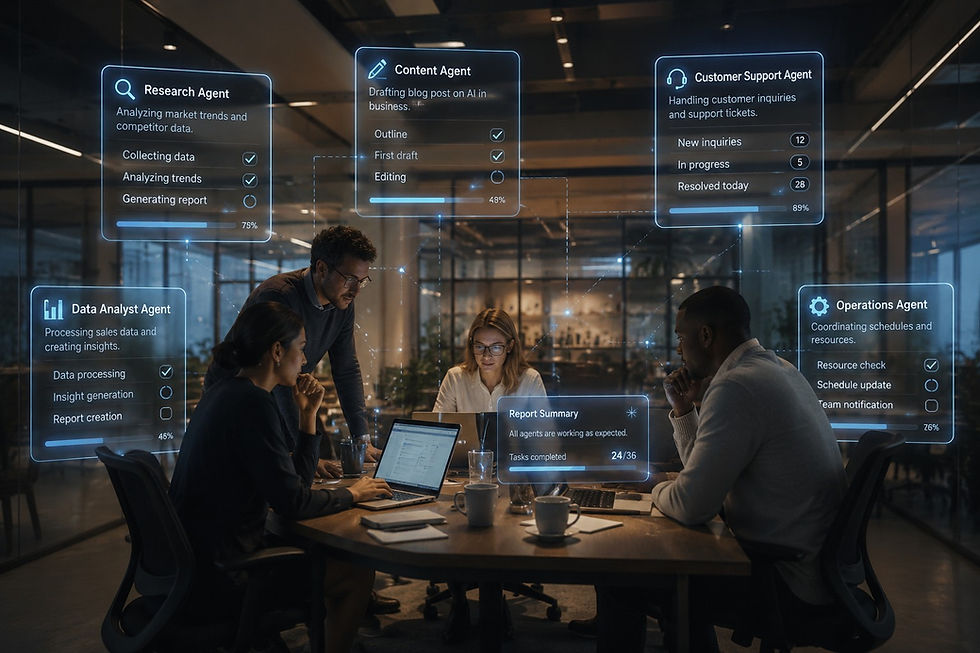
This shift is part of a broader transformation in how humans are beginning to work alongside intelligent systems. (Read more: The Rise of AI Co-Workers: Are We Managing Them, or Replacing Ourselves?)

The New Divide: AI Users vs Non-AI Users Is Already Here
Unlike previous technological revolutions, this one is not defined by access. AI tools are widely available. From writing and research to coding and design, the barriers to entry are lower than ever. But access doesn’t guarantee adoption.
Across industries, two types of professionals are emerging. On one side are those who have started to integrate AI into their workflows—using it to accelerate thinking, execution, and decision-making. On the other are those who remain cautious, skeptical, or simply unchanged in their approach.
At first glance, the difference between the two groups may seem marginal. A slightly faster turnaround here, a more refined output there. But over time, small differences compound. The individual using AI begins to:
Produce more in less time
Experiment more frequently
Learn faster through iteration
Meanwhile, the non-user continues to operate within traditional constraints. This is not a dramatic disruption; it’s a widening gap. And once that gap reaches a certain point, it becomes difficult to close.
Productivity Has Become Asymmetrical
For decades, productivity followed a relatively predictable curve. Experience, skill, and effort determined output. Improvement was incremental and often linear. AI breaks that model; It introduces asymmetry. Two individuals with similar experience and intelligence can now operate at entirely different levels of output—simply based on how they use AI.
One person may spend hours researching, structuring, and executing a task. Another may use AI to compress that entire process into a fraction of the time, allowing them to focus on refinement, strategy, or expansion. This doesn’t just save time. It changes how time is used.
AI users are not just working faster—they are reallocating their effort toward higher-value activities. Over time, this leads to better outcomes, stronger positioning, and increased opportunities. And importantly, this advantage is not static, rather, it grows. Because the more someone uses AI, the better they become at directing it. And the better they direct it, the more value they extract. That feedback loop is where the real shift lies.

From Skill Gap to Leverage Gap
The workforce has always been shaped by skill gaps. Differences in education, experience, and specialization created natural hierarchies of performance. But AI is introducing a new kind of gap—one that is less visible, but more impactful: a leverage gap.
It’s no longer just about what you know. It’s about how effectively you can amplify what you know. An AI-enabled professional may not be more skilled in the traditional sense. But they are more leveraged. They can:
Extend their capabilities beyond their core expertise
Execute across multiple domains
Test and iterate at a speed that was previously impossible
This changes how value is created. In a system where output increasingly defines opportunity, those with higher leverage naturally move ahead. Not because they are inherently better, but because they are operating with a different multiplier. And once leverage becomes the defining factor, traditional measures of performance begin to shift.
Why the Gap Between AI Users and Non-AI Users Will Keep Growing
Some technological advantages level out over time. As tools become mainstream, early adopters lose their edge and the playing field evens out. AI is unlikely to follow that pattern. The advantage of AI is not just in access—it’s in usage depth.
Two individuals may have access to the same tools, but their outcomes can differ dramatically based on how they use them. One treats AI as an occasional assistant. The other treats it as an integrated system—something they think with, not just use. This difference compounds.
The integrated user builds better workflows, develops sharper prompting instincts, and gains deeper insight into how to extract value. Over time, their baseline level of performance increases.
Meanwhile, the occasional user remains static. This creates a widening curve, where the gap is not just maintained—it accelerates. And because AI itself is improving, those who are already integrated are better positioned to take advantage of each new advancement. The result is a dynamic where early and consistent adopters continue to pull ahead.
The Future of Work Will Be Defined by Integration
The future of work is often discussed in terms of automation, job displacement, and industry transformation. But at a more immediate level, it is being defined by something simpler: integration i.e. how deeply is AI embedded into the way you work?
For some, AI remains a tool—useful, but optional. For others, it has become foundational. It shapes how they approach problems, generate ideas, and execute tasks and this distinction matters. Because in a competitive environment, the baseline is constantly shifting. What was once considered high performance becomes standard. And those who operate below that evolving standard begin to fall behind—not suddenly, but progressively.
This is the new divide. It is not enforced by systems or institutions. It is created by individual choices—how one adapts, experiments, and evolves. While it may not feel urgent in the moment, its long-term impact is significant. The individuals who integrate AI into their workflows are not just improving efficiency. They are redefining what is possible within their roles.
A Quiet Shift With Lasting Consequences
The most important changes in business and work are not always the most visible ones. They don’t arrive with headlines or immediate disruption. They build gradually, shaping outcomes over time. The divide between AI users and non-AI users is one such shift.
It is not about replacement; it is not about sudden obsolescence; it is about relative movement. Some individuals are moving faster—learning more, producing more, adapting more quickly. Others are moving at the same pace they always have. Individually, these differences may seem small. Collectively, they redefine competition. And over time, they determine who leads—and who struggles to keep up.



Comments