
AI Won’t Replace You—But Someone Using AI Might

Artificial intelligence is not replacing humans—but it is reshaping competition. Individuals who use AI tools are increasingly outperforming those who don’t, creating a new divide in productivity, creativity, and opportunity.
As Sam Altman put it, "AI won’t replace humans—but humans who use AI will replace those who don’t."
That distinction changes everything. Because it shifts the focus from technology to behavior—and from fear to adaptation.

The Real Shift Isn’t Automation—It’s Augmentation
For most of modern history, technology has been about replacing effort. Machines took over repetitive labor, software automated processes, and systems improved efficiency at scale.
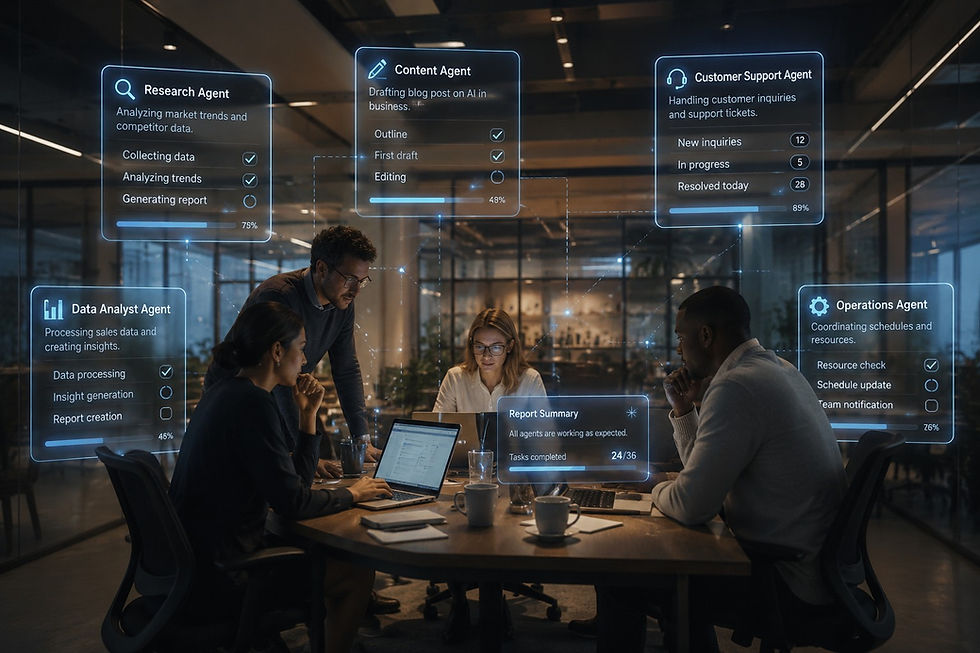
AI is different, it doesn’t just automate tasks—it amplifies human capability. It enables individuals to think faster, create more, and execute at a level that previously required teams. A single person can now:
Generate content at scale
Analyze complex data in minutes
Prototype ideas without technical barriers
This is not replacement, it’s augmentation. And in a world where output increasingly defines value, augmentation becomes a competitive advantage.
The Rise of the AI-Enabled Individual
The most significant impact of AI may not be at the organizational level—but at the individual level. We are witnessing the emergence of a new kind of professional: the AI-enabled individual. Someone who doesn’t just use tools but integrates them into their thinking and workflow.
This changes what productivity looks like. Where teams once required layers of specialization, individuals can now operate across functions:
A marketer who writes, designs, and analyzes
A founder who prototypes without engineers
A creator who produces at the pace of a media company
The result is not just efficiency—it’s asymmetry. Small players begin to compete with large ones. Individuals begin to outperform teams. Speed becomes strategy.
A New Kind of Divide Is Emerging
The traditional divide in the workforce was based on skills, education, or access to opportunity. Today, a new divide is forming—one that is less visible, but potentially more impactful for those who integrate AI into their work and those who don’t.
This gap compounds over time. The AI-enabled individual improves faster, produces more, and adapts quicker. Meanwhile, those who resist or delay adoption risk becoming relatively slower—not because they lack ability, but because they lack leverage. This is what makes the shift subtle but powerful. It’s not about being replaced overnight. It’s about being outpaced over time.
From Tools to Thinking Systems
What makes AI different from previous technologies is not just what it does—but how it fits into human cognition. AI is not just a tool you use. It’s increasingly a system you think with. It helps to refine ideas, challenge assumptions and accelerate decision-making.
Over time, this creates a feedback loop. The more you use AI, the better you become at directing it. And the better you direct it, the more powerful it becomes. This is where the real advantage lies—not in access, but in integration.
The Future of Work Is Behavioral
The future of work will not be defined solely by technological advancement, but by human response to it. Two individuals with access to the same tools can produce vastly different outcomes based on how they use them.
Curiosity, adaptability, and willingness to experiment become more valuable than static expertise. In that sense, AI is less of a technological revolution and more of a behavioral one. It rewards those who learn continuously, adapt quickly and rethink how work gets done.
The Question Isn’t If—It’s How
The idea that AI will replace humans is compelling—but incomplete. The more relevant question is: how will humans evolve alongside AI?
The real disruption isn’t AI replacing humans. It’s AI creating a performance gap between those who use it—and those who don’t.
Because the future is unlikely to belong to machines alone. It will belong to those who learn how to work with them—effectively, intelligently, and strategically. And in that future, the difference won’t be between humans and AI, it will be between humans who adapt—and those who don’t.



Comments