
The Agentic Economy Is Coming: What Happens When AI Starts Doing the Work?

For the past few years, the defining question around artificial intelligence was whether machines could generate. Could AI write an article, create an image, build software, summarize a report, analyze a spreadsheet, or answer a complicated question? Generative AI made those capabilities accessible to almost anyone with a browser and a prompt.
The next phase is asking a much more consequential question: what happens when AI stops waiting for instructions and starts doing the work itself? That is the promise of agentic AI. Unlike a conventional chatbot, an AI agent can be given an objective rather than simply a question. It can reason through a task, use software tools, retrieve information, interact with systems, and work through multiple steps toward an outcome. OpenAI describes this transition as a shift from individual AI interactions toward delegated, longer-horizon tasks, with agents increasingly able to work independently for extended periods.
The distinction may sound technical, but its business implications are enormous. If generative AI changed the economics of producing information, agentic AI could change the economics of executing work. Instead of asking an AI to draft an email, an employee could eventually ask it to manage an entire communication workflow. Instead of asking for a market summary, a business could delegate research, analysis, comparison, and reporting to an agent. Instead of using software one screen at a time, workers could increasingly tell an AI what outcome they want and allow it to operate the underlying systems.
The result could be a new kind of economy in which businesses employ not only people and software, but also increasingly capable digital workers.
From AI Assistants to AI Workers
The first generation of workplace AI largely waited for humans to tell it what to do. An employee opened a chatbot, entered a prompt, received an answer, and then decided what action to take. The human remained firmly in the middle of the process.
Agents begin to change that relationship because they are designed around objectives rather than isolated interactions. An employee might ask an agent to research a market, compare suppliers, prepare a recommendation, update a database, draft communications, and return with a completed result. The system may need to use several tools, retrieve information from different sources, evaluate intermediate results, and correct its approach before finishing the task. That makes the workflow, rather than the individual prompt, the new unit of automation.
This shift is already visible in the way frontier AI companies are using their own systems. In June 2026, OpenAI reported that Codex had evolved from being primarily a developer tool into a major internal AI system used across departments including legal, finance, recruiting, research, and operations. OpenAI also reported that users were increasingly assigning Codex tasks estimated to represent hours of human work rather than short interactions.
The significance goes beyond Codex itself. It suggests that as agents become more capable, people may increasingly move from asking AI for answers to delegating outcomes. That is a very different model of software. Traditional software waits for a person to navigate menus, enter information, select options, and initiate actions. An agent can increasingly navigate the software itself. The employee provides the objective, the boundaries, and the judgment; the agent handles more of the execution.

This is why the largest technology companies are building infrastructure specifically for agents. Microsoft describes Agent 365 as a control plane designed to help organizations observe, secure, and govern agents across the enterprise. Google Cloud is similarly positioning its enterprise AI products around agents capable of executing complex, multi-step processes rather than simply answering questions.
The transformation is therefore moving beyond the chatbot interface. The next generation of workplace AI may not simply be something employees talk to; it may be something employees delegate to.
The Agentic Economy Could Change How Companies Are Designed
If agents become reliable enough to execute multi-step workflows, businesses may eventually begin redesigning their operations around them rather than simply adding AI to existing processes. Imagine an inventory system that does more than report that a product is running low. An agent could monitor demand, identify a potential shortage, review approved suppliers, compare options, prepare a recommendation, and request human approval before placing an order. In customer service, an agent could identify an issue, retrieve the customer's history, determine the appropriate response, update internal systems, and escalate unusual cases to a human employee.
The important question then becomes less "Where can we add AI?" and more "Which parts of this business should be performed by humans, agents, or both?" That is a much more profound organizational question. Google Cloud has described the emerging "agentic enterprise" as one in which businesses redesign operations so AI agents and human experts can collaborate, rather than simply inserting AI into existing workflows. Its current enterprise strategy explicitly focuses on agents that can reason through complexity and orchestrate business processes.

This could eventually change the relationship between employees and enterprise software. Today, a worker might operate ten different applications to complete one business process. They may have to remember where information lives, understand the quirks of each system, move data between platforms, and manually coordinate every step. An agentic interface could make much of that invisible.
Instead of learning how to operate every system, an employee could increasingly describe the desired outcome while an agent interacts with the systems behind the scenes. That could have major implications for software companies themselves. For decades, enterprise software has competed partly on interfaces, features, integrations, and ease of use. In an agentic world, the interface may become less important because the user does not necessarily need to interact with every application directly.
The software still exists, but the human may no longer need to see it. This could create a new layer of enterprise technology sitting between people and the applications they use today. Agents could become the interface through which employees access CRM systems, financial platforms, project management tools, databases, communication systems, and internal knowledge. In that sense, the agentic economy is not simply about automating employees, it is about reorganizing how work moves through a company.
The Biggest Challenge Isn't Intelligence. It's Trust
The promise of AI agents comes with an obvious problem: once software can act independently, mistakes become more consequential. A chatbot that produces an incorrect answer is frustrating. An agent that sends an incorrect message, changes a database, exposes confidential information, makes an inappropriate purchase, or triggers the wrong workflow can create a much larger problem. That makes trust one of the defining infrastructure challenges of the agentic economy.
Organizations will need to know which agents exist, what permissions they have, what systems they can access, what decisions they are allowed to make, and when a human must intervene. They will also need to monitor what agents actually do rather than simply assuming that a system behaves as intended.
Microsoft's Agent 365 strategy illustrates this emerging requirement. Its platform is designed around agent identity, observability, security, and governed access, reflecting a broader shift in enterprise AI from experimentation toward management at scale.
Google Cloud is confronting the same problem from another direction. Its current agent infrastructure emphasizes development, deployment, governance, and security because agents increasingly interact with multiple systems and data sources. Google has explicitly argued that autonomous enterprise systems require a foundation capable of sustaining trust and reliability.
This suggests that the agentic economy will create an entirely new category of business infrastructure. There will be agents, but there will also be systems for managing agents. There will be AI capable of performing work, but there will also be identity systems, security controls, monitoring platforms, audit trails, permissions, and governance frameworks designed to make that work safe.
In other words, the future of AI may depend as much on control as capability. And that is why the transition will probably be more gradual than some of the most aggressive predictions suggest. The technical ability to complete a task is only one part of the equation. Organizations also need confidence that the task can be performed reliably, securely, repeatedly, and within clearly defined boundaries. The agentic economy will not arrive simply because AI becomes smarter, it will arrive when businesses become comfortable letting AI act.
What Happens When Work Becomes Delegatable?
The most interesting consequence of agentic AI may not be that companies suddenly eliminate large numbers of jobs. It may be that the definition of a job itself begins to change. If an agent can research information, prepare a first draft, monitor routine processes, coordinate systems, and execute repetitive workflows, human workers may spend less time navigating software and more time setting objectives, evaluating outcomes, solving unusual problems, managing relationships, and making decisions where judgment matters.
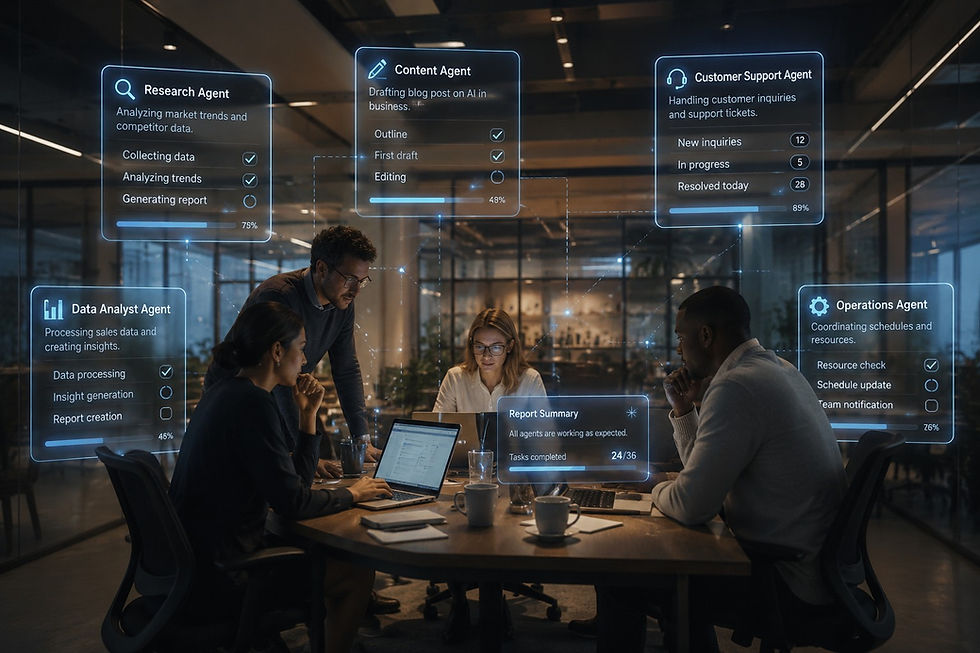
A single employee could potentially become the manager of several specialized AI agents. One might handle research. Another could monitor operations. Another could prepare financial analysis. Another could manage routine customer interactions. The human would not necessarily disappear from the process; their role could move further upstream. That creates an interesting possibility for businesses.
The productive capacity of a company may no longer be determined only by how many employees it has or how much software it owns. It could increasingly depend on the combination of people, agents, data, computing infrastructure, and the workflows connecting them.
OpenAI's recent research provides an early glimpse of this transition. The company reported that agentic usage is expanding beyond developers and that non-technical employees are increasingly using Codex for work that crosses traditional job boundaries. The company argues that more capable agents allow people to take on longer and more complex tasks. That does not mean every job becomes an AI job, or that autonomous agents are ready to replace entire departments. It means the boundary around what one person can accomplish may begin to move and that may be the most important economic effect of all.
The first phase of AI asked whether machines could produce something. The second phase asks whether machines can complete something. That is a much bigger shift. When AI generates a report, the human still has to decide what to do with it. When an agent can research the issue, analyze the information, prepare the report, update the relevant systems, and execute approved next steps, the human role begins to move from performing the workflow toward directing and supervising it.
The workplace of the future may therefore contain fewer purely digital tools and more digital actors. The agentic economy will not simply be about smarter artificial intelligence. It will be about delegated intelligence—systems that do not merely tell people what to do, but increasingly act on their behalf.
The companies that benefit most may not necessarily be those with the largest number of AI agents. They may be the ones that understand where autonomy creates genuine value, where human judgment remains essential, and how to build the infrastructure that allows the two to work together. The question is no longer whether AI can do the work. Increasingly, it is becoming: How much of the work are we prepared to let it do?


Comments