
Inside the Billion-Dollar IPL Machine: How the Indian Premier League Became India’s Most Powerful Business Platform

Updated: May 12
Part of the Series: The Business of Modern Sport — exploring how leagues, athletes, and media are reshaping global commerce.
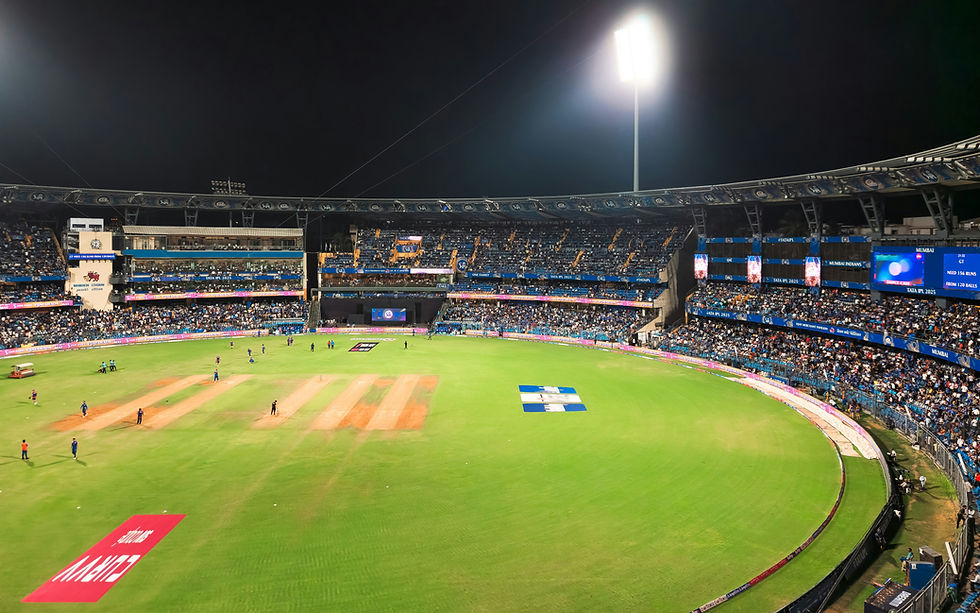
There are sporting events, and then there are economic systems disguised as sport. The Indian Premier League belongs firmly in the latter category. What began as a bold experiment in franchise cricket has evolved into one of the most powerful commercial ecosystems in global sport. The IPL is no longer defined by overs, wickets, or match results. It is defined by scale—of money, of attention, of cultural relevance. In India, cricket was always popular. The IPL turned that popularity into infrastructure.
From Tournament to Economic Engine
At its core, the IPL operates less like a league and more like a multi-layered marketplace. Every match is not just a sporting contest—it is a convergence point for media, brands, technology platforms, and millions of consumers interacting in real time.
The transformation is visible in numbers, but its real significance lies in structure. Franchises such as Mumbai Indians and Chennai Super Kings are no longer just teams. They are brand entities with independent identities, loyal fan bases, and long-term commercial strategies. Their value is not tied to seasonal performance alone, but to sustained engagement. This is what separates the IPL from traditional tournaments. It is not episodic—it is continuous.
Media Rights: The Foundation of Scale
No discussion of the IPL’s business dominance is complete without acknowledging its media ecosystem. The league’s broadcasting rights have reached staggering valuations, involving major players like Disney Star and Viacom18. These deals are not just about airing matches—they are about controlling one of the largest attention streams in the country.
In a fragmented media landscape, the IPL offers something rare: mass, simultaneous, emotionally invested viewership. For broadcasters and streaming platforms, this is not content, it is leverage. The shift toward digital streaming has further amplified this. Viewers are no longer passive—they are interactive, mobile, and constantly engaged across platforms. The IPL exists not just on screens, but across feeds, reels, conversations, and communities.
Athletes as Scalable Assets
In the IPL ecosystem, players are more than athletes. They are scalable business assets. Figures like Virat Kohli and MS Dhoni operate at the intersection of sport, brand, and culture. Their presence drives viewership, influences sponsorship deals, and shapes fan engagement at scale.
This is not incidental, it is structural. The IPL amplifies individual visibility in ways that traditional formats cannot. A player’s performance is instantly translated into digital traction, brand value, and commercial opportunity. Social media, endorsements, and storytelling extend their influence far beyond the field. For brands, this creates a powerful proposition: access to personalities that already command trust, attention, and emotional connection.
The Sponsorship Economy: Visibility at Scale
The IPL is, in many ways, the most efficient advertising platform in India. Every element of the league is monetized:
team jerseys
stadium signage
strategic timeouts
digital integrations
in-game branding
But what makes it uniquely effective is context. Unlike traditional advertising, IPL sponsorships are embedded within moments of high emotional intensity. A boundary, a wicket, a last-over finish—these are not just sporting moments; they are attention spikes. Brands positioned within these moments benefit from heightened recall and association.
This is why companies across sectors—technology, finance, consumer goods—continue to invest heavily in IPL partnerships. It is not just about visibility. It is about relevance at scale.
Franchises as Independent Brands
One of the IPL’s most important innovations is the franchise model. Teams are not extensions of a central authority; they are independent brands with their own identities, strategies, and narratives. Over time, they have built distinct personalities, for example, Mumbai Indians as a symbol of consistency and dominance whereas Chennai Super Kings as a representation of loyalty and legacy.
These identities are cultivated through player retention, visual branding, storytelling and fan engagement. The result is a form of loyalty that goes beyond the sport itself. Fans do not just watch matches—they align with teams. They wear their colors, follow their narratives, and participate in their communities. This transforms the IPL from a tournament into a network of micro-brands operating within a larger system.
The Digital Layer: Where IPL Expands
If television built the IPL, digital platforms are scaling it. The modern IPL experience is multi-screen by default. Viewers watch matches while simultaneously engaging on social media, consuming highlights, sharing reactions, and participating in real-time conversations.
This creates a feedback loop; on-field action drives online engagement and online engagement amplifies on-field narratives. Platforms like streaming apps and social media channels extend the lifespan of every moment. A single highlight can generate millions of views long after the match has ended. For brands and platforms, this is invaluable. It turns time-bound events into ongoing content streams.
The Fan Economy: Loyalty as Currency
At the heart of the IPL’s success is its fan economy. Fans are not passive spectators; they are active participants creating content, driving conversations and building communities. Their loyalty is measurable—not just in viewership, but in engagement, merchandise purchases, and digital activity.
This loyalty translates directly into economic value. It attracts sponsors, justifies media rights deals, and sustains franchise growth. In many ways, the IPL has mastered what modern business seeks to achieve: turning attention into a structured, monetizable ecosystem.
Why IPL Works Where Others Don’t
Many leagues around the world have attempted to replicate the IPL model. Few have achieved similar success. The reason lies in alignment. The IPL sits at the intersection of a cricket-obsessed population, a rapidly growing digital ecosystem and an expanding consumer market.
It leverages all three simultaneously. More importantly, it understands that modern sport is not just about competition—it is about experience. The IPL blends sport with entertainment, narrative, and commerce in a way that feels cohesive rather than forced.
The Business Implication: A Platform, Not a League
For brands, the IPL represents something larger than sponsorship opportunity. It is a platform, a place where visibility is guaranteed, engagement is amplified and association is meaningful. Unlike traditional advertising channels, the IPL offers integration into a cultural moment. It allows brands to become part of conversations rather than interrupt them. This distinction is critical.
The significance of the IPL extends beyond cricket. It offers a blueprint for how modern business operates:
build around attention
create continuous engagement
integrate across platforms
monetize multiple layers simultaneously
In this sense, the IPL is not just influencing sport—it is influencing how industries think about growth, branding, and consumer interaction.
A System That Keeps Expanding With Attention
What makes the IPL particularly powerful is that it is still evolving. New technologies, new formats, and new forms of engagement continue to emerge. Each addition expands the ecosystem rather than disrupting it.
This adaptability ensures longevity. The IPL is not dependent on a single factor—be it players, platforms, or formats. It is supported by a network of interdependent elements, each reinforcing the other.
The Indian Premier League did not just capitalize on cricket’s popularity—it restructured it. It transformed a sport into a platform, a tournament into an economy, and attention into a scalable asset. In doing so, it redefined what a sports league can be because in today’s world, the most valuable resource is not talent, or even content, it is attention. And the IPL has mastered how to capture, sustain, and monetize it at a scale few others can match.


Comments