
From Tools to Systems: How AI Is Replacing Human Decisions in Business

Updated: May 1
Part of the “Invisible Economy” series—exploring how AI and infrastructure are quietly reshaping modern commerce.
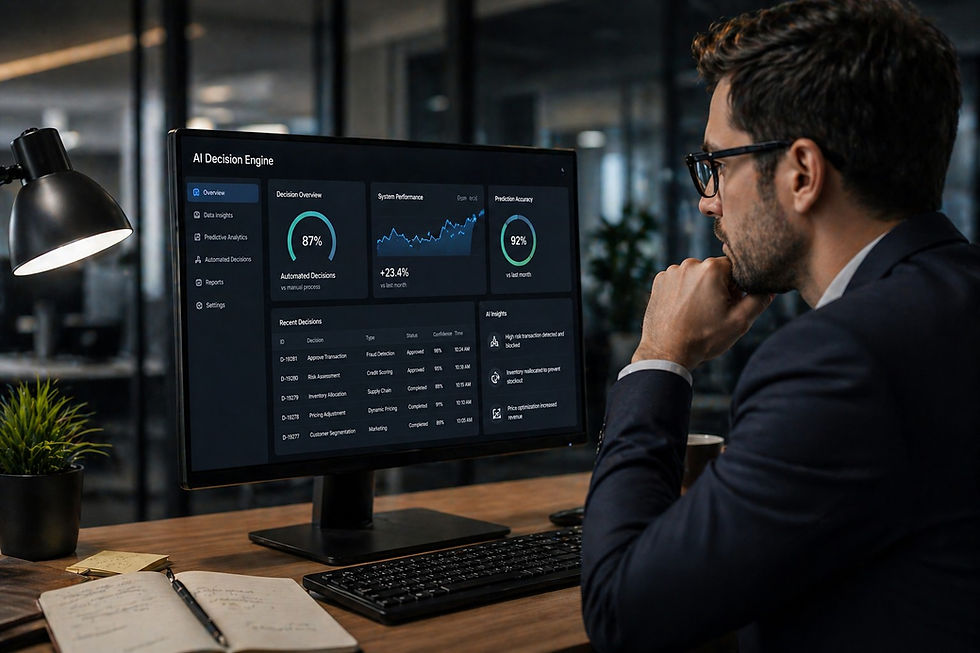
For most of modern business history, technology was a tool. It helped humans move faster, organize better, and execute at scale—but decisions remained human. Strategy, judgment, and direction were considered uniquely human domains, supported by machines but never defined by them.
That boundary is now quietly disappearing. Artificial intelligence is no longer just assisting execution. It is increasingly influencing—and in many cases making—decisions that were once considered exclusively human. This is not a dramatic, overnight shift. There are no obvious moments where control is handed over. Instead, decision-making is being gradually restructured—distributed across systems, algorithms, and continuous feedback loops. And as this happens, the nature of business itself is changing.
How AI Is Replacing Human Decisions in Business
The transition from tools to systems marks one of the most important shifts in modern business. Tools are reactive. They respond to human input, execute defined tasks, and depend on direction. Systems, on the other hand, are proactive. They process data continuously, generate insights independently, and increasingly guide outcomes without waiting for instruction.
In traditional workflows, decision-making followed a clear structure. A human identified a problem, gathered information, evaluated options, and made a choice. Technology supported each step, but the final judgment remained human.
AI systems collapse this entire process. They continuously analyze data at a scale impossible for humans, identifying patterns that are not immediately visible. They recommend actions in real time, execute decisions automatically in certain cases, and learn from outcomes to refine future behavior. What used to be a discrete moment—a decision—is now an ongoing process embedded within the system itself.
This shift is already visible across industries. Pricing adjusts dynamically based on demand signals. Marketing campaigns optimize themselves in real time. Supply chains respond to disruptions before they escalate, rerouting logistics without waiting for human intervention. In many of these scenarios, humans are no longer making the decision. They are observing it.
Why Businesses Are Trusting Systems Over Human Judgment
At first glance, delegating decisions to systems may seem risky. Business has long relied on experience, intuition, and contextual understanding—qualities that machines were once thought to lack. But AI systems offer something fundamentally different: consistency at scale.
They do not fatigue under pressure, rely on incomplete memory, or react emotionally to short-term fluctuations. Instead, they operate on continuously updated data, processing vast amounts of information in real time and identifying correlations that would otherwise go unnoticed.
This creates a subtle but powerful shift in trust. Decisions that were once debated in meetings are now increasingly deferred to systems—not because humans are incapable, but because systems are becoming more reliable in specific contexts. Over time, this reliability builds confidence, and confidence leads to delegation.
This is not about whether AI is replacing human decisions; it is about redistributing it. Humans are no longer required to make every decision. Instead, they design the frameworks within which decisions are made. This reflects a broader transformation already underway—where AI is not just supporting work but redefining human roles within it.
The Rise of Decision Infrastructure
What is emerging is not just a new toolset, but an entirely new layer in business: decision infrastructure. Just as physical infrastructure enabled industrial growth, and digital infrastructure enabled the internet economy, decision infrastructure is enabling a new operational model—one where decisions are embedded directly into systems.
In this model, workflows are no longer managed step-by-step. They are automated end-to-end, continuously optimized based on real-time data. Outcomes are not static—they evolve as the system learns. This is visible in companies building at the intersection of technology and finance. Platforms like Stripe, for example, are not just processing transactions—they are embedding decision-making directly into infrastructure. Risk assessment, fraud detection, and payment optimization are handled within the system itself, often without human intervention.
The implications are significant. When decisions are embedded into infrastructure, they become faster, more scalable, and less dependent on individual expertise. Startups and AI-native companies are already building around this model, designing systems that can execute, adapt, and improve autonomously.
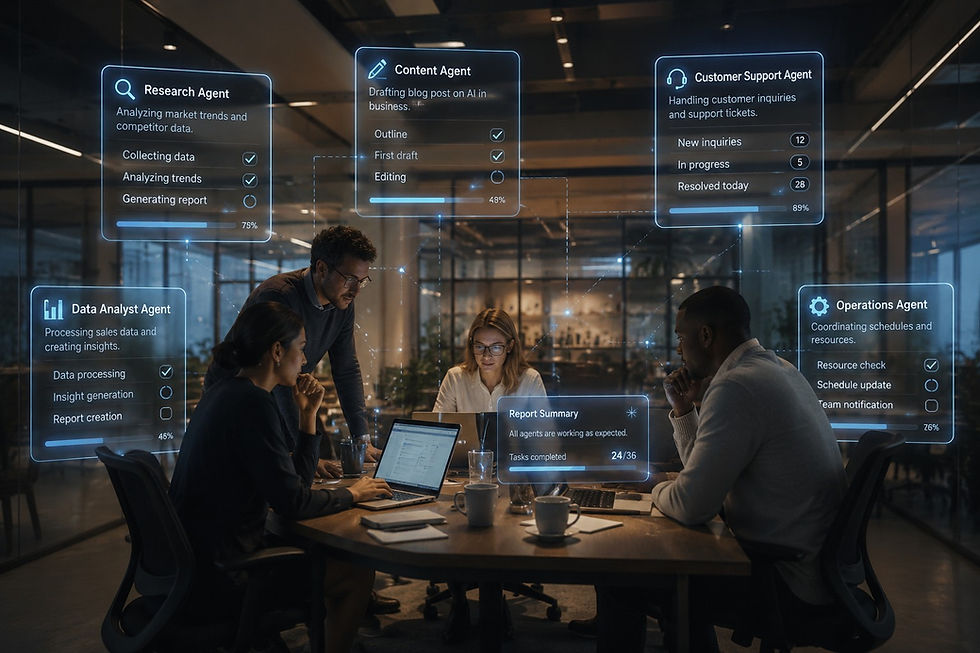
This is why some of the fastest-moving companies today are not necessarily the largest—but the most system-driven. And importantly, much of this decision-making becomes invisible. There are no meetings, no approvals, no visible checkpoints. A recommendation is generated, an action is executed, and a result is measured—all within a continuous loop. The “decision” as we traditionally understand it disappears.
This changes how organizations perceive control. Leaders may still feel in charge, but much of the operational decision-making is happening within systems that run independently. Over time, this creates a gap between perceived control and actual influence. And as systems become more advanced, that gap is likely to widen.
The Strategic Trade-Off: Designing Systems Instead of Making Decisions
At the core of this transformation lies a fundamental trade-off. By delegating decisions to systems, businesses gain speed, efficiency, and scalability. They can respond to complexity in real time, operate across larger datasets, and maintain consistency across operations.
But in doing so, they also shift away from direct control. This is not necessarily a loss—it is a redefinition. Leaders are no longer primarily decision-makers. They are system designers. Instead of asking, “What decision should we make?”, they must ask, “What system should make this decision—and how should it operate?”
This requires a different set of capabilities. It involves understanding how systems process data, defining boundaries within which they operate, and monitoring outcomes rather than inputs. It also requires trust—not just in people, but in the systems themselves. This is a higher level of abstraction, but also a more scalable form of influence.
Beyond Decision-Making: A Quiet Shift in Business Power
The shift from tools to systems is not just a technological evolution—it is a structural one. It changes how work is performed, how organizations are designed, and how competitive advantage is created. In a system-driven world, success is no longer defined by making better individual decisions. It is defined by building better systems—systems where data flows seamlessly, decisions are automated intelligently, and outcomes improve continuously.
This is where the idea of the “invisible economy” becomes increasingly relevant. Much of the value in modern business is no longer visible in traditional ways. It is embedded in systems, algorithms, and infrastructure that operate quietly in the background. The most important decisions are not always discussed in meetings—they are executed within systems.
And as this layer expands, the distinction between human-driven and system-driven work becomes less clear. The question is no longer what decision should be made. It is who—or what—is making it and in many cases, the answer is already changing.



Comments